
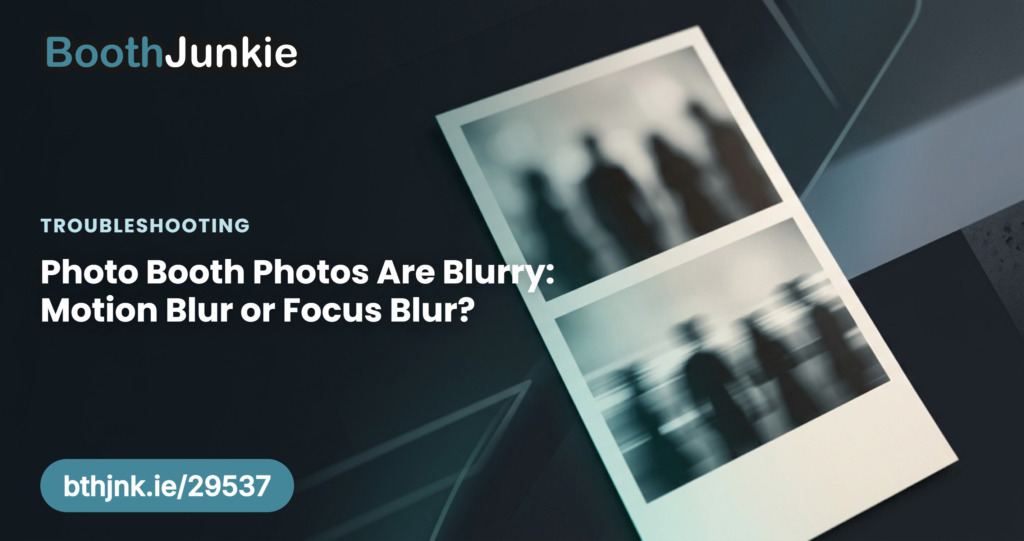
“The photos are blurry” is two completely different faults wearing the same description, with two completely different fixes. Before changing anything, work out which one you have — it takes one glance at a photo and saves an evening of adjusting the wrong thing.
Which blur is it?
Find a photo you are unhappy with and look at something in it that was not moving — the backdrop, the edge of the booth, a chair, a sign on the wall.
If the stationary things are sharp and only the people smear, that is motion blur. A waving hand trails while the wall behind it stays crisp.
If everything is soft, including the things that never moved, that is focus blur. The whole frame is uniformly mushy.
That single check tells you which half of this article to read, and it is the first thing to report if you ask anyone for help. “Everything is soft, including the backdrop” and “the guests smear but the booth is sharp” send a support conversation in opposite directions.
Motion blur
Motion blur means the subject moved while the shutter was still open. It is the same reason people had to sit perfectly still for portraits nearly two hundred years ago — the exposure lasts long enough for movement to record as a smear.
In a photo booth this is almost always a lighting consequence rather than a camera fault.
A constant LED is a weak light. To get a correct exposure from it the camera has to hold the shutter open longer — and a booth is full of people laughing, waving props and leaning in. With flash the shutter is open roughly a quarter as long, and the burst itself is over in a fraction of that, which is what freezes people mid-movement.
So the fixes, in order of how well they work:
- Use flash instead of a constant light. This is the real fix. It is bright enough to allow a much faster shutter, and it eliminates the problem rather than reducing it.
- Raise the shutter speed and open the aperture or raise ISO to compensate. This works up to a point, and the point is how much light you have.
- Add more light. More light buys shutter speed. A brighter constant source is better than a dim one.
- Do not ask guests to stay still. They will not, and the photos are worse when they try.
If you are already on flash and still getting smearing, check that the shutter speed has not been left slow from a constant-light setup — with flash the exposure is governed by the burst, so a slow shutter is doing nothing for you except letting ambient movement record.
Focus blur
Focus blur means the camera did not focus where you needed it to. Everything is soft because nothing is in the focal plane.
Booths are unusually prone to this for one reason: guests stand at a fixed distance, but the camera keeps trying to work it out afresh — often in the dark, and often against a plain backdrop with nothing to lock onto.
- A dim venue gives autofocus nothing to work with. This is the one genuine advantage of a constant LED: it lights the subject continuously, so the camera can see to focus. With flash there is no light between shots at all.
- A plain backdrop makes it worse. Autofocus needs contrast. A smooth sequin wall or a flat colour is close to a blank page.
- Focus can be set once and left. A booth shoots the same framing, at the same distance, all night. Focusing manually and locking it removes the whole category of problem — this is what most experienced operators end up doing.
How to focus your photobooth camera correctly walks through setting it properly.
A common combination worth naming: operators who move to flash to solve motion blur sometimes acquire focus blur in the process, because they have removed the light the camera was focusing by. If that happens, a small constant light alongside the flash gives autofocus something to see without putting a bright light in anyone’s eyes — or lock the focus manually and stop relying on it entirely.
A quick reference
| What you see | What it is | First thing to change |
|---|---|---|
| People smear, backdrop sharp | Motion blur | Move to flash, or raise the shutter speed |
| Everything soft, including the backdrop | Focus blur | Lock focus manually at the guest position |
| Soft only in dark venues | Focus blur | Give the camera light to focus by |
| Worse as the night goes on | Usually motion blur | The venue is dimming; your shutter is lengthening |
Related
- Photo booth lighting explained: constant LED vs flash — the trade-off underneath both faults
- Why your photo booth live view is dark — the one real cost of moving to flash, and how to remove it